|
Getting your Trinity Audio player ready...
|


Feminism always brings the woman into comparison with the man. From the school debates of childhood- “Men are better than women.” ; “Women are better than men.”; the mindset is planted early that life is a competition between the two genders.
And that mindset does not stop there. Even today, whenever someone speaks to women about how to live, how to be godly, how to grow, the immediate response is: “What about men?”




If men lead, women must lead in the same way.
If men speak with hardness, women must speak with hardness too.
If men can actually go bare‑chested, women should be able to bare their breasts also.
If men call theirs ‘chest’, women can also call theirs ‘chest’, why breasts? So, I ‘chestfeed’ not ‘breastfeed’. No, imagine such folly!
If men dress this way, women must dress same way.
That was where it all started, sis. With feminism!


It is always this refrain: “We too can do it.”
Now in Nigeria, women fashionably wear Agbada. I even joined a final year activity then in school where we were to cross-dress. How undiscerning!
What a man can do, a woman can do very very very well!
Why must everything always return to men?
Why can a woman not be addressed as a woman without dragging a man into it?
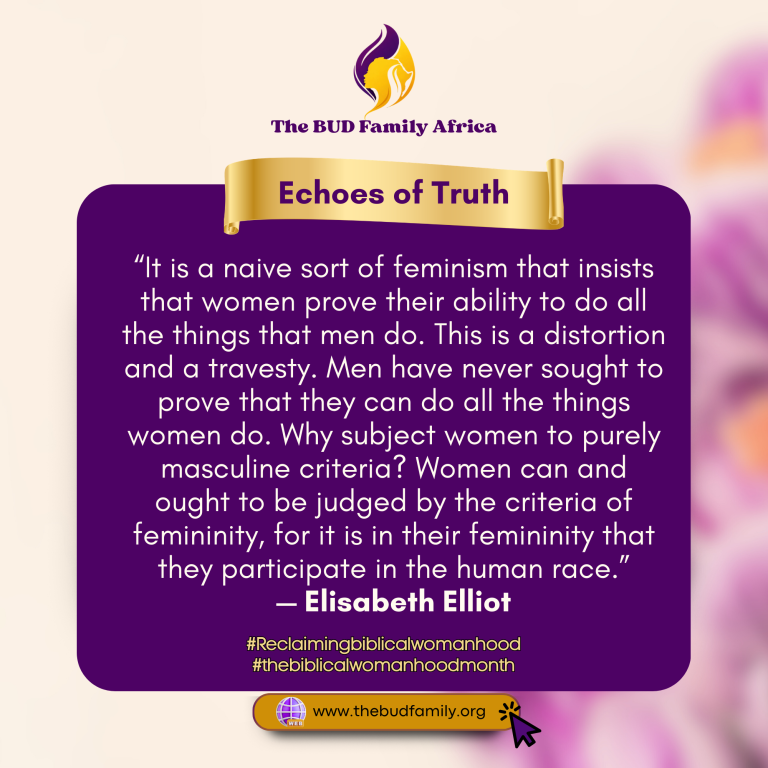
This is the distortion Elisabeth Elliot warns about in the echoes of truth for today.
Feminism has made the standard man. So everything about the woman is now measured by him.
Yes! Feminism is at it again.
It wants to change everything and make the women men and the men, women. This is the goal that’s why Gloria Steinem (1970s) said: “We’ve begun to raise daughters more like sons… but few have the courage to raise our sons more like our daughters.”





You see?
Feminism in Waves
Feminism didn’t come all at once; it came in something called waves.
Each wave had its own focus, its own fight, and its own way of showing rebellion. And one of the loudest ways feminists showed their rebellion was through clothing. Fashion became their protest sign. I want to take this example and thresh it a bit for today.
For centuries, women dressed in ways that were unmistakably feminine. Long skirts, layered petticoats, corsets that shaped the waist, delicate shoes, and dresses that covered the body. By today’s standards, we might call it “a lot,” but it was beautiful, modest, and distinct. The clothing reflected womanhood as soft, dignified, and set apart.

But in the mid‑19th century, feminism rose up against this. Loud voices began to call traditional dress “chains” and “tyranny.” Thus began the Dress Reform Movement. This movement occurred in the different waves of feminism, each with its own different clothing styles.
Waves of Feminism
First Wave Feminism (19th Century)
The first wave of feminism rose in the 1800s, with its main focus on women’s suffrage. This was about the right to vote and basic civil rights. But alongside the political fight came a cultural protest, and clothing became one of its loudest symbols. Women had always dressed in distinctly feminine ways: corsets that shaped the waist, long skirts that swept the ground, and layered dresses that covered the body.
By today’s standards, it may seem “a lot,” but it was unmistakably feminine. Feminists began to call this “tyranny” and “chains.”
Then, Amelia Bloomer promoted trousers under shorter skirts, and Elizabeth Cady Stanton declared in affirmation that the bloomer costume was “a protest against the tyranny of fashion.”
Mary Livermore described corsets and long skirts as “chains of fashion which bound women to weakness and dependence.”
So, that was how what had once been a mark of femininity was now treated as oppression. Clothing became rebellion. Feminists argued that to be free, women must dress like men.

Second Wave Feminism (1960s–70s)
The second wave came nearly a century later, in the 1960s and 70s, and its focus was workplace rights and reproductive freedom. Women were now free to enter the workplace in greater numbers, and feminists demanded equality in careers and control over their bodies. Fashion reflected this protest.
This wave was louder, more confrontational, and more radical in its use of fashion. Designers like Yves Saint Laurent introduced the women’s pantsuit which was a direct challenge to male‑dominated workplaces. The pantsuit’s statement was: “We belong in the office, and we will dress like men to prove it.”
At the same time, Mary Quant popularized the miniskirt, which threw modesty aside and became a symbol of sexual liberation. Fashion was no longer about beauty or dignity. It became protest, a way of proving women were like men.
No need to be homey, girly, motherly, or feminine. The message was: “We own ourselves. We decide what happens with our bodies. We will not be defined by children or kitchens.”
Feminism used clothing to declare independence from modesty, motherhood, and the very idea of femininity.
The general message was clear: femininity was weakness, and liberation meant rejecting it.

Third Wave Feminism (1990s)
By the 1990s, feminism entered its third wave, focused on gender and sexual freedom. This wave pushed even harder against distinction.
Rudi Gernreich designed unisex clothing. These are outfits that looked the same for men and women and even created topless swimsuits for women. The idea was that equality meant erasing difference. Clothing blurred the lines between male and female, modesty and exposure.
So, the message was: “Equality means sameness.” Feminists insisted that to be free, women must not only dress like men but erase the very categories of male and female. What God designed as distinct was treated as a problem to be solved.





Fourth Wave Feminism (2000s–Present)
The fourth wave, beginning in the 2000s and continuing today, focuses on identity politics, visibility, and activism. Fashion became activism itself. Shirts printed with slogans like “We Should All Be Feminists” turned clothing into political statements. Women protested bare‑chested, insisting that if men can do it, women should too. Trousers became celebrated not for practicality but as symbols of empowerment. Feminism used fashion to make rebellion visible, wearable, and unavoidable. The body itself became a protest sign. The message was: “Our clothes are our activism. We will use fashion to fight.”

Also Read: How Feminism Traps the Heart
Effect on the Women in the Church
The sad thing is that this change was not just happening outside in the world. As it was happening, it was quietly entering the church as well.
Before these reforms and before feminism gained ground, women in the church had clarity. Their dressing was modest, covered, and distinctly feminine. It was not something they were debating. It was understood. A woman did not feel the need to look like a man to be respected. She dressed as a woman, gladly.
Her role was also clear. She honored her husband, nurtured her children, kept her home, and grew in godliness. She was not trying to compete. She was not trying to prove anything. The Scriptures say a gentle and quiet spirit is of great worth before God, and women embraced that without feeling reduced.
Then the first wave of feminism came in the 19th century. It focused on rights, especially voting. But it came with a questioning spirit, not just about society, but about design. Even in the church, small shifts began. Dress reform ideas started to appear. Bloomers and altered clothing styles entered gradually, in a more ‘decent’ way. It was presented as practicality, but it was already pushing against distinction.
Roles also began to be questioned subtly. The idea that a woman’s place in the home was honorable began to weaken in some circles. The seed had been planted.

Then came the second wave in the 1960s and 70s, and this is where things became much louder. Feminism now began to directly challenge roles. Not just in society, but in the church.
This was when what is now called evangelical feminism began to rise. It started to reinterpret the Scriptures. Passages about submission, headship, and order were no longer accepted as they were. They were explained away, softened, or redefined.
Women were no longer just entering workplaces. They were now pushing into roles that had been clearly reserved for men in the church. The ordination of women into pastoral leadership began to spread in many denominations. What had been clearly taught in Scripture began to be debated.
At the same time, dressing in the church began to shift more visibly. Trousers became normal among Christian women. Modesty was redefined. The line between the church and the world began to blur.
Homemaking also took a hit. It began to sound like something small, something lesser. Women began to feel that staying at home or focusing on family meant they were not doing enough. The pressure to prove themselves outside the home became strong, even among believers.

By the third wave in the 1990s, things went even further. The argument was no longer just about rights or roles. It was now about identity itself.
Distinction between male and female was increasingly challenged. In the church, this showed up in deeper ways. Women were not only being ordained, but the very idea of difference in roles was being rejected in many places. Everything was becoming interchangeable.
Dressing also followed this pattern. Clothing became more androgynous or more revealing. What used to be clearly inappropriate slowly became accepted. The sense of shamefacedness and sobriety the Scriptures speak about began to disappear.
Even language changed. Words like submission, modesty, and quietness began to sound offensive. Teachings that were once straightforward became controversial.

And now, my dear sisters, in this present wave, the effect is even deeper!
In many places, the church no longer looks different from the world in these areas. Women dress the same way as the world. The body is no longer guarded. Exposure is normalized.
And in roles, the shift is even more serious. The idea of headship is rejected. The idea of submission is resisted. Women stand in pulpits, lead congregations, and take on roles the Scriptures did not assign to them, all in the name of equality.

What is this all built on?
The same idea.
That equality means sameness!
So instead of honoring God’s design, the goal becomes removing distinction.
But the Scriptures say God created male and female. That means difference is intentional. It is not something to fight.
The Scriptures say that in the church, there is order. There are roles. There are boundaries given by God, not to reduce anyone, but to reflect His wisdom.
When these things are removed, confusion enters.
So what started as a movement outside slowly entered inside.
What was once resisted became tolerated.
What was tolerated became accepted.
And now, in many places, it is defended.
It even Went Beyond Clothing
It was not only in clothing that feminism made its protest for women to be like men. The ideology seeped into every outward expression of womanhood.
Feminists deliberately reshaped hair, insisting that women could wear low cuts or shave their heads, usually as a statement after divorce or conflict, as if to say, “I do not need to look soft or feminine anymore.”
Speech was reshaped too; no longer gentle or gracious, it became hard, confrontational, and aggressive. Sexuality was redefined: if men could sleep around, then women should also, no need for any dignity.
Homemaking was dismissed as a trap. “We can’t be making the home; aren’t we living in it with the men? Now that we are in the workplace, oh, no more homemaking!”
Behavior followed the same path: if men could walk bare‑chested in singlets, women declared they could go bare‑chested without bras.
If men drank, smoked, and did drugs, women insisted they could do it too and even better. The mantra became: “What a man can do, we also can do better!”
My sisters, the underlying goal was to reject femininity altogether. Feminists wanted to show that they were not bound by what society called “womanly.” They wanted to prove they could live, act, and even look like men.
Some even went so far as to claim they could become “fathers,” declaring that women did not need men at all. But in this pursuit of sameness, the beauty of God’s design was lost. Scripture says: “Male and female He created them.” (Genesis 1:27).
We Need Not be Uninformed!
Many today do not even know about the dress reforms. It is hidden history, buried under what we now call “fashion trends.” We have accepted all the different dress styles as okay, but they were not always okay.
Personally, when I watched old American movies/news, I noticed the women dressed modestly, with dignity, and I began to wonder: when did everything change?
That question led me into research some years back. It was not easy to find, but I am glad I did, because it opened my eyes.
I am sure that a number of things that are now normal to us might even have roots in rebellion against God’s design.
Practices, habits, and attitudes that feel ordinary today may actually have been born out of protest. That is why discernment is so important. Scripture warns: “Do not be conformed to this world, but be transformed by the renewal of your mind.” (Romans 12:2).
We cannot simply accept what the world calls normal. We must test everything against God’s Word.
What the world calls “freedom” may actually be bondage.
What the world calls “fashion” may actually be rebellion.
What the world calls “progress” may actually be distortion.
That is why uncovering these hidden histories matters because it reminds us that culture is not neutral.
As Christian women, we are called to reclaim modesty, dignity, and femininity not as chains, but as crowns.
Wake Up, African Christian Women!
African women, we must wake up to this.
Many of us have become comfortable receiving whatever comes from the West without questioning it. If it trends there, we adopt it here. If it is accepted there, we normalize it here. And before long, we begin to think that whatever is happening “over there” is the standard for what is right, even in the things of God.
You will even hear it said on pulpits, “In this our own part of the world…” as though another part of the world is the measure of spiritual correctness. Since when did geography become the standard for truth?
Sadly, we do Christianity carelessly in Africa. There is little distinction left. In dressing. In conduct. In roles. In homes. In churches. Everything has now started to look the same. Male and female, blurred. Order, questioned. Structure, resisted.
And what is more concerning is that some even defend these things without realizing what they are supporting. They call it balance. They call it growth. They call it “understanding the times.” But if it is not rooted in Scripture, what exactly are we understanding?
We cannot afford to be uninformed.
The Scriptures say, “Do not be conformed to this world.” That includes ideas that sound intelligent but quietly oppose God’s design.
If we must earnestly contend for the faith, then we must return to the Word seriously.
They Comparing Themselves with Themselves are Not Wise
So, in conclusion, Elisabeth Elliot’s words cut right to the heart of the matter.
“It is a naive sort of feminism that insists that women prove their ability to do all the things that men do. This is a distortion and a travesty. Men have never sought to prove that they can do all the things women do. Why subject women to purely masculine criteria? Women can and ought to be judged by the criteria of femininity, for it is in their femininity that they participate in the human race.”
What she is saying is that feminism, in its zeal, demanded women prove themselves by copying men. It set up “masculine criteria” like toughness, aggression, sexual freedom, workplace dominance and told women they must measure themselves by those standards.
But how absurd! Men don’t try to prove they can do all the things women do. They do not strive to prove they can nurture children, sustain homes, or embody gentleness. So why should women be forced to prove themselves by imitating men?
Like Mrs. Elliot said, this is a travesty because it erases the very glory of womanhood. True womanhood is not found in sameness with men, but in the beauty of difference.
Scripture says: “Male and female He created them.” (Genesis 1:27). Femininity is not a mistake. It is not oppression. It is participation in the human race as God designed it.
Paul calls a woman’s hair her glory (1 Corinthians 11:15). Peter calls a gentle spirit “of great worth in God’s sight” (1 Peter 3:4). Proverbs calls homemaking a noble calling (Proverbs 31:27‑28).
So the quote for today reminds us that women do not need to erase femininity to be equal. They do not need deep voice to prove strength, nor rebellion to prove freedom. They can be judged by the criteria of femininity and in that, they reflect the image of God.
As we round off, this is the truth yet again: feminism demands sameness, but God designed difference.
Feminism erases femininity on all fronts,in all ways, but God calls it glory.
Feminism seeks freedom in rebellion against God, but true freedom is found in Christ.
Sissssss, that is enough. God’s way is enough.
That is dignity.
That is womanhood rightly lived.
The Sovereignty of God and the Sanctity of Marriage | Voddie Baucham
Discover more from The BUD Family Africa
Subscribe to get the latest posts sent to your email.


Post navigation
Previous Post
 Oh, When a Woman Says ‘Yes’!