|
Getting your Trinity Audio player ready...
|

Step-by-Step Breasts Self-Examination
By Miss Adeseye Precious
Self Breast Examination simply means checking your own breasts by yourself.
You don’t need any special instrument, chemical, or machine.
It is simple, it is gentle, and it does not require plenty energy.
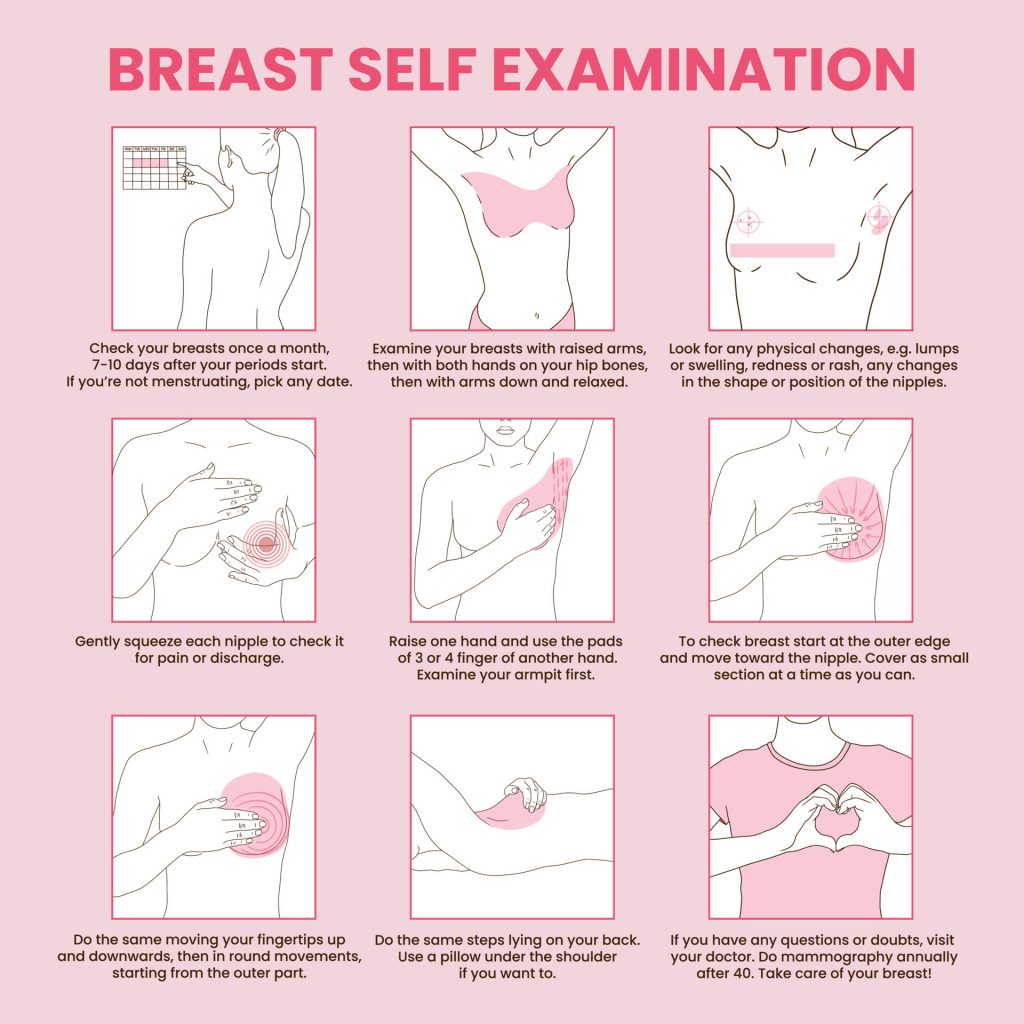
Before touching your breasts, the first thing to do is to LOOK at them. Visual examination always comes before the touch.
STEP 1: VISUAL EXAMINATION
Stand or sit shirtless and braless in front of a mirror.

Start by putting your arms at your sides. Look at your breasts with your shoulders straight and your arms on your hips.
Observe both breasts carefully. Look out for:

- Puckering or dimpling
- Changes in size or shape
- Differences in symmetry
- Redness, rash, soreness
- Swellings
- Any unusual lines or ridges
Lift each breast gently to see if the lower ridges look the same on both sides.
Take note of anything unusual.
STEP 2: RAISE YOUR ARMS
Raise your arms and look again for any changes.
If you notice anything new, write it down immediately.

STEP 3: LOOK FOR NIPPLE DISCHARGE
Check for any fluid coming out of your nipples.
This may be watery, milky, yellowish, or even bloodstained.
A woman who is not pregnant or breastfeeding should not have nipple discharge.
If you do, stay calm, but note it and seek medical attention.
STEP 4: FEEL YOUR BREASTS WHILE LYING DOWN
Lie down and use your right hand to examine your left breast and vice versa.
Use the first three finger pads. Keep them flat and firm.
Move in a circular motion, covering the entire breast:
- From collarbone to upper abdomen
- From armpit to cleavage
You may start from the nipple and move outward in circles or go up and down vertically like mowing a lawn.
Choose a method and stick to it so you do not miss any area.
STEP 5: FEEL YOUR BREASTS WHILE STANDING OR SITTING
Many women prefer doing this in the shower when the skin is wet and slippery.
Use the same circular motion to cover every part.
When is the best time to do a breast exam?
One week after your menstrual period.
This is when your breasts are least tender or swollen.
Women who no longer menstruate should choose a fixed day every month.
How often should you examine your breasts?
Once every month.
NORMAL FINDINGS
Not every lump or change is dangerous.
Breasts feel different in different places and at different times of the month.
Examples of normal findings:
- A firm ridge at the bottom of each breast
- Slight tenderness during your cycle
- Mild swelling before your period
Breasts also change naturally as you age.
NOT-NORMAL FINDINGS
Contact a doctor or qualified nurse if you notice:
- A hard lump or knot in the breast or underarm
- Thickening or fullness that feels unusual
- Skin dimpling, puckering, or bulging
- A recently inverted nipple
- Redness, warmth, swelling, or pain
- Itching or rashes
- Bloody nipple discharge
Early detection saves lives.
A lump found early is far easier to treat than one found late.
Please don’t be afraid—just be responsible.
MAKE IT ROUTINE
The more you examine your breasts, the more familiar you become with what is normal for you.
Do it every month. Don’t skip it. Don’t postpone it.
Also Read: Stress and your health
Discover more from The BUD Family Africa
Subscribe to get the latest posts sent to your email.